Blog · Science’s Last Exam
Science’s Last Exam: Can AI do Scientific Research on Its Own?
In October 2026, OpenAI released more than 700 mathematical manuscripts generated by its internal model, with machine-checkable Lean proofs for some of the results. The prospect of AI doing its own research is becoming concrete.
The release raises a broader question: given a research goal, how far can an AI agent get on its own? Real research rarely goes to plan. Researchers must diagnose what went wrong, find the gaps between evidence and hypothesis, and decide what to investigate next.
To find out, we built Science’s Last Exam (SLE), a benchmark of real research tasks. SLE tests whether AI can carry out a complete research cycle on its own and deliver results that withstand scrutiny. The project is led by the AItonomy Foundation, a US nonprofit. Researchers from 34 institutions, including Harvard University, MIT, Stanford University, the University of Oxford, Princeton University, and Oak Ridge National Laboratory, design and review its tasks in their personal capacities. SLE currently includes 113 public tasks across nine disciplines: statistics, physics, astronomy, chemistry, earth science, biology, engineering, materials science, and medicine.

End-to-end research (To be expanded)
SLE gives an agent a research goal, plus the materials and tools to pursue it, not a test question with ready-made steps. The agent chooses its methods, runs computations or queries, analyzes the results, and decides what to do next.
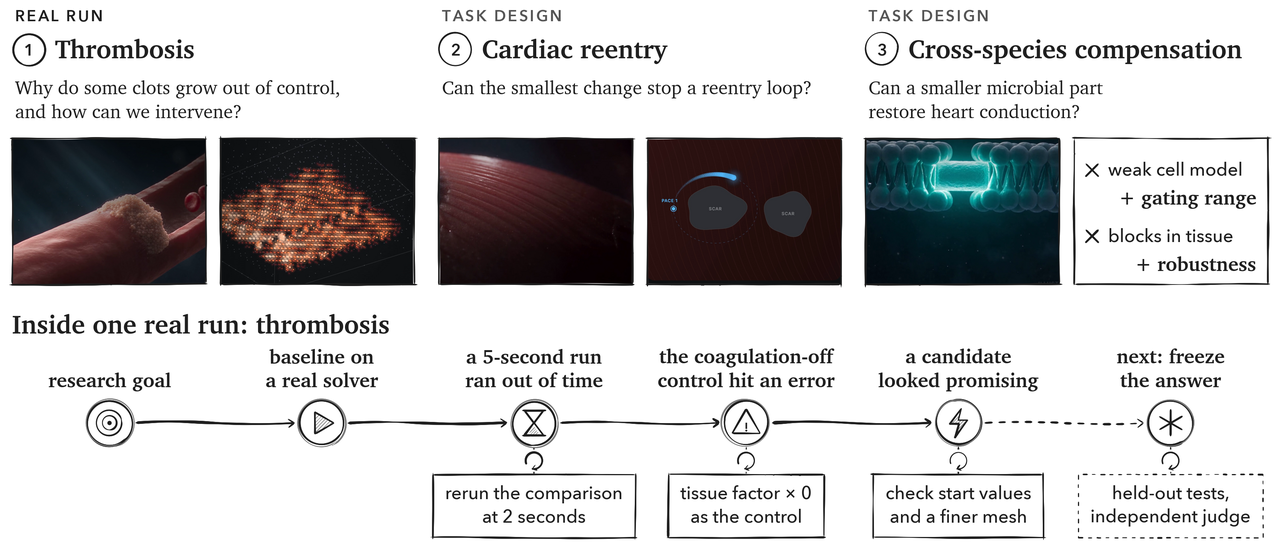
Take one task: what is the lowest dose of an antithrombotic drug that stops dangerous clots without impairing normal bleeding control? Working with ticagrelor in a computational model, it must pick the lowest total daily dose and a dosing interval from a set of candidate regimens, and the choice must hold across different vessel geometries, flow conditions, and drug-response profiles. Suppressing clots is only half the requirement: a regimen that works at peak concentration may wear off before the next dose, or prevent clotting so well that a damaged vessel can no longer seal.
The agent has to link drug concentration over time with local blood flow and platelet response, and use each failure to choose the next experiment: adjust the dose or interval, test another mechanism, or probe where the regimen breaks, all within a limited compute budget. Even a workable regimen is not the end. Could the dose go lower? Does it hold under other conditions? If clot suppression and normal hemostasis cannot both be achieved, the agent must map the drug’s limits and state where the evidence is still insufficient.
An end-to-end research task asks whether AI can keep forming hypotheses, choosing experiments, and handling counterexamples until both its conclusions and their limits stand up to scrutiny.
What Counts as Completing a Piece of Research
Research also means judging when the evidence supports a conclusion, so every closed-loop task ends with independent verification. The agent submits research artifacts that can be opened, inspected, and re-run. Once submitted, the answer is frozen and judged by checks that were sealed in advance and kept hidden from the agent.
Domain experts define these checks for each research question. For a force-field prediction model, for example, they test whether it satisfies physical constraints, whether its results can be independently recomputed, and whether those results hold on held-out data the agent never saw. They run programmatically, without ad hoc human grading. While it works, the agent is free to change its methods and judgments, but only its final artifacts are graded. SLE therefore sees both how the AI conducts research and whether its result meets the task’s requirements.
Pinpointing Where AI Gets Stuck
A full research task shows whether an AI succeeded; improving it requires knowing where it gets stuck. SLE assesses six scientific capabilities alongside one end-to-end research assessment:
| Assessment | Research Question to Answer |
|---|---|
| Hypothesis Discovery | Can it formulate valuable, testable hypotheses from real data? |
| Protocol Planning | Can it understand how operations alter experimental states and plan reasonable subsequent steps? |
| Scientific Computing | Can it fix scientific code to obtain scientifically valid computational results? |
| Scientific Software Operation | Can it use specialized software to complete tasks and deliver practical artifacts that meet specifications? |
| Wet-lab Execution (In construction) | Can its protocols produce experimentally verified results when carried out in a real laboratory? |
| Experiment Observation | Can it accurately interpret experimental visuals and distinguish directly observed facts from inferences? |
| End-to-end research (To be expanded) | Can it connect the six capabilities into a complete research cycle and deliver results that pass independent verification? |
These capabilities are used again and again in a research project: one observation can change an experimental plan, and one calculation can overturn a hypothesis. Comparing capability scores with closed-loop outcomes shows whether an agent lacks a specific skill or fails to connect the skills it already has.
Closed-loop tasks measure overall research performance, while capability diagnostics point to concrete directions for improvement.
Leaderboard results
Score / 100 · Higher is better
- Claude Opus 5.5N/A
- GPT-6 AstraN/A
Note: Claude Opus 5.5 and GPT-6 Astra are not yet evaluated. Their provider-enforced biological safeguards can restrict biology research workflows[Anthropic][OpenAI]; results will be added once research access is approved.
Next Step: Entering the Real Laboratory
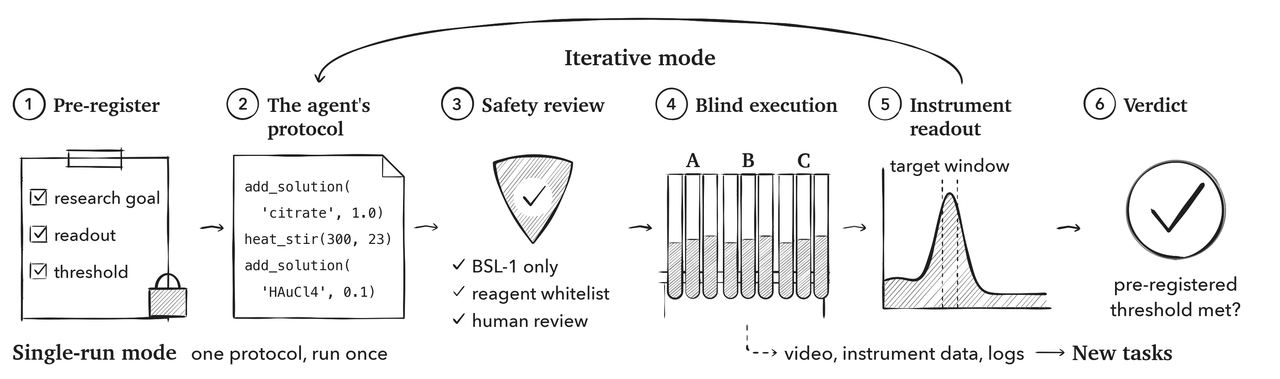
Beyond computation, SLE is building wet-lab execution tasks for a future release. Protocols designed by AI will be carried out in real laboratories, with results verified by automated benchtop instrument readouts. In closed-loop mode, the experimental data, result images, and execution logs go back to the agent, which revises its protocol and starts the next round.
Physical experiments give more direct feedback: what actually happens on the bench when the agent’s protocol is carried out? When results fall short, can the AI find the causes worth investigating and use them to improve the next experiment?
Bring Your Hardest Problems to SLE
SLE will officially launch on November 6. The release will open-source all 113 public tasks, including an end-to-end research task. Every public task is a standalone, directly executable package: researchers can test their own agents and models, or submit agents for evaluation on the leaderboard.
We are looking for researchers in more disciplines to build new tasks with us. An experiment you have refined many times, a computation that needs domain judgment to move forward, or a result that only specialists in your field know how to verify could become AI’s next exam. You can contribute research questions, datasets, scientific tools, or verification methods, or design a closed-loop task for your field with us. Teams with laboratory facilities are also invited to join the upcoming wet-lab validations.
Can AI do scientific research on its own? Bring your hardest scientific questions, and let us answer it together through concrete tasks and research results.
SLE Official Website · Leaderboard · Contribute & Collaborate
Media and citation enquiries: ly1988@princeton.edu or wuyc@stanford.edu.